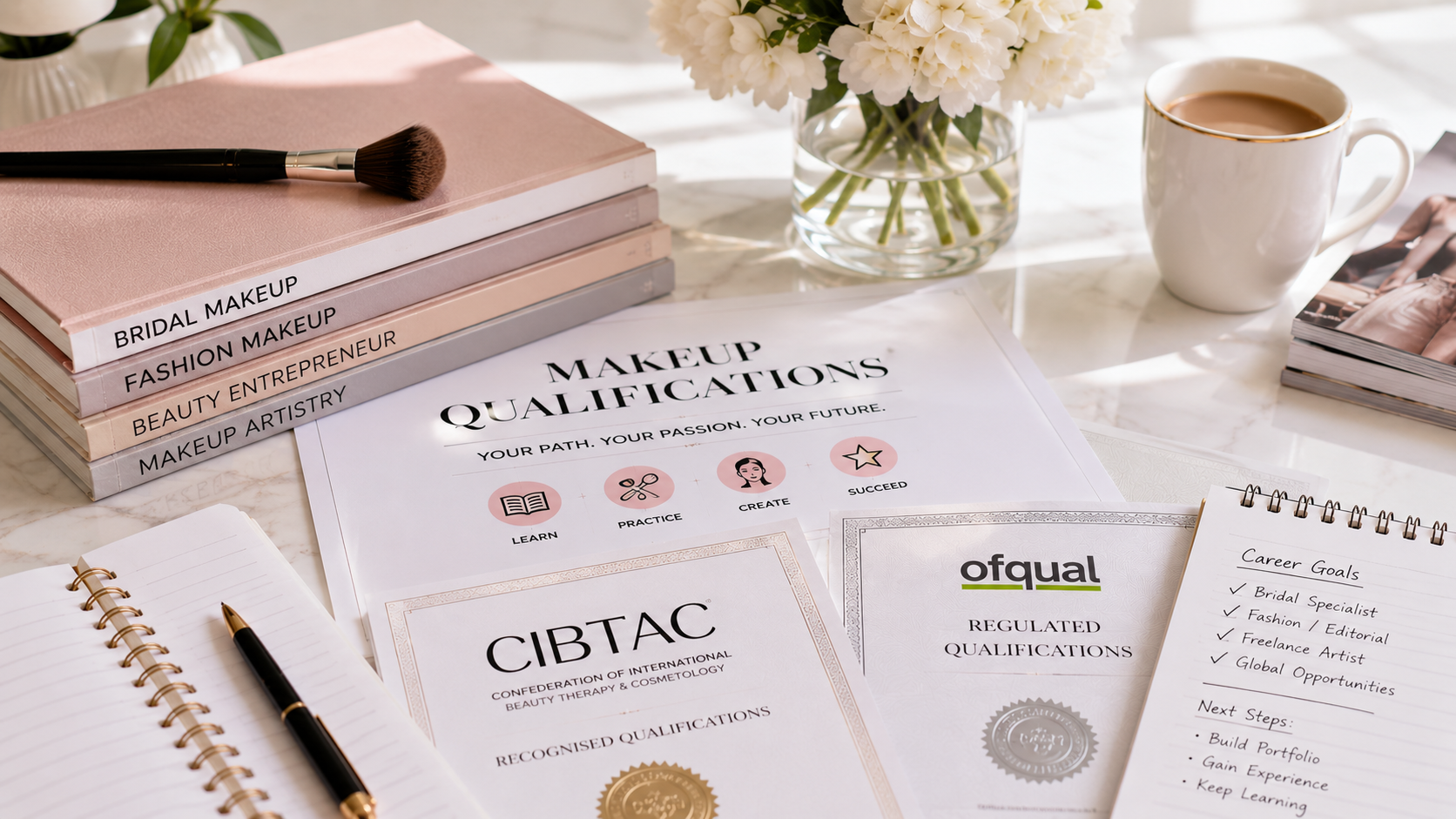
Choosing between makeup qualifications can feel more complicated than learning a new technique. Course pages use words such as accredited, regulated, approved, award, certificate and diploma, yet those terms do not all mean the same thing. If you plan to work in bridal, fashion, media, SFX or international freelance makeup, understanding them will help you invest in training with confidence.
The simplest explanation is this: Ofqual regulates qualifications, examinations and assessments in England. CIBTAC is a specialist awarding organisation for beauty and makeup qualifications, and Ofqual regulates it. A makeup academy delivers the education and may prepare students for one or more external qualifications. These roles connect, but they are not interchangeable.
Makeup qualifications in one minute
For a quick answer, remember these five points:
- Ofqual is a regulator, not a makeup school and not the certificate you receive.
- CIBTAC is an awarding organisation that develops and awards specialist beauty and makeup qualifications.
- The academy is the training provider, where you learn, practise and complete any required assessments.
- The qualification level describes difficulty, while Award, Certificate or Diploma usually describes its size.
- A regulated qualification supports credibility, but your portfolio, hygiene, speed and professionalism still determine whether people book you.
Therefore, when a course mentions Ofqual, ask for the exact qualification title and awarding organisation. When it mentions CIBTAC, ask whether you will complete a regulated qualification, an endorsed programme or an academy certificate.
What is Ofqual?
Ofqual is the Office of Qualifications and Examinations Regulation. It regulates academic, vocational and technical qualifications in England, and its responsibilities include maintaining standards and confidence in the qualifications it oversees. It also maintains information about regulated qualifications so learners can check and compare them.
However, Ofqual does not normally teach students or issue their course certificate directly. Instead, it regulates recognised awarding organisations and the qualifications they offer. In this context, the awarding organisation creates the qualification, sets assessment requirements and quality assures delivery through approved centres.
You may see the phrase “Ofqual accredited makeup course” used informally. The more precise question is: which named qualification is Ofqual regulated, and which awarding organisation issues it? A credible provider should be able to show the full title, level and qualification number where applicable.
What is CIBTAC?
CIBTAC stands for the Confederation of International Beauty Therapy and Cosmetology. It has offered qualifications in beauty, spa and related fields since 1977, and it operates as an Ofqual-regulated awarding organisation. CIBTAC lists its Ofqual registration number as RN5124.
For makeup students, CIBTAC is relevant because its qualification range follows clear career stages. Its current makeup pathway includes a Level 2 Award in Providing Make-Up Application, a Level 3 Certificate in Fashion and Photographic Make-Up, a Level 3 Certificate in Media Make-Up, and a Level 3 Diploma in Fashion, Photographic and Media Make-Up.
CIBTAC describes Level 2 as covering core skills such as day, evening and bridal looks. In contrast, its Level 3 options move towards more advanced fashion, photographic, theatre, television and media techniques, with areas such as body art and airbrushing appearing at this stage. Consequently, the right level depends on the work you want to pursue, not simply which title sounds most impressive.
Levels, awards, certificates and diplomas explained
Two separate ideas sit inside most regulated makeup qualifications: level and size.
What does the level mean?
The level indicates how challenging the learning and assessment should be. Government guidance explains that a higher level represents greater difficulty, although two qualifications at the same level can cover different amounts of content.
In practical terms:
- Level 2 often builds core application, client care, hygiene and service skills.
- Level 3 usually expects greater independence, technical range and professional judgement.
- A higher level is not automatically the best starting point if you have not mastered the foundations.
What do Award, Certificate and Diploma mean?
These labels mainly describe qualification size, calculated through learning and assessment time. CIBTAC explains that Award, Certificate and Diploma designations sit alongside the level, rather than replacing it.
Therefore, a Level 3 Diploma normally covers more content than a Level 3 Award, but both may demand work at Level 3. Do not assume that the word “diploma” always means more advanced. Check both the level and the total learning requirements.
A regulated qualification versus an academy certificate
An academy certificate confirms that you completed a particular school programme. It can still carry value, especially when the academy has a strong reputation and the course includes serious practical training. However, it is not automatically the same as an externally awarded, regulated qualification.
A regulated qualification normally has:
- A formal title and level
- A named awarding organisation
- Defined learning outcomes
- Assessment requirements
- Quality assurance
- A qualification number that can be checked on the official register
Meanwhile, an endorsed training programme may have external quality assurance without being identical to a regulated RQF qualification. For this reason, ask the provider to explain exactly what you receive rather than relying on the word “accredited” alone.
How AOFM approaches makeup qualifications
AOFM offers academy training alongside optional external qualification routes across selected programmes. Its qualifications information references CIBTAC, City & Guilds, BABTAC and Ofqual-regulated options, while its Dubai programmes also reference KHDA and QAD. The exact combination varies by course and location, so students should check the individual programme before enrolling.
For example, AOFM’s longer London programme combines hairstyling with beauty, professional bridal, fashion, photographic makeup, creative concepts, airbrush, Asian and Arabic bridal, SFX and media makeup. Its current course information also says students may apply for several individual certificates from external bodies, subject to the programme’s terms and optional assessment routes.
Similarly, the academy’s wider professional programmes connect makeup qualifications with portfolio shoots, teaching from working freelance artists and continued guidance. This matters because a qualification should support your career development, not sit separately from the practical skills that clients and creative teams actually assess.
What makeup qualifications can do for your career
Strong makeup qualifications can give employers, clients and other training providers a clearer benchmark of what you have studied and demonstrated. They can also support progression because regulated pathways often move from core application towards specialist fashion, photographic or media work.
In addition, formal assessment can strengthen your working habits. You may need to demonstrate consultation, hygiene, health and safety, client care, planning and application, rather than simply recreate a tutor’s look. CIBTAC’s Level 2 and Level 3 specifications describe both practical and knowledge-based assessment, which reflects the wider demands of professional work.
However, a qualification cannot guarantee bookings. A bride will still judge your finish, communication and reliability. A fashion team will still notice your speed, kit discipline and ability to follow a brief. Therefore, treat the qualification as evidence of a professional foundation, not as a replacement for experience.
Choosing the right qualification for your goal
Bridal and private clients
For bridal work, start with strong core makeup application. You need skin preparation, colour correction, undertone matching, eye shaping, lashes, consultation, hygiene and long-wear techniques.
A Level 2 makeup qualification can provide a useful foundation. However, add practical training in diverse skin tones, mature skin, hair awareness and bridal trials if you want to build a competitive service.
Fashion and photographic makeup
Fashion requires clean technique, speed and visual judgement. Therefore, a Level 3 fashion and photographic route may suit students who already understand basic complexion, eyes and lips.
At the same time, choose a programme that includes portfolio work and collaboration. The qualification can show assessed learning, but clients need images that prove you can interpret styling, lighting and a creative brief.
Media, theatre and SFX
If you want film, television, theatre or SFX, look closely at the syllabus. A general beauty qualification may not cover continuity, character work, casualty effects or screen-specific finishing.
For this reason, check whether the programme includes a dedicated media qualification or specialist practical modules. Also ask how much time you will spend applying effects, documenting continuity and working under realistic production conditions.
International freelance work
International recognition is not automatic permission to work in every country. Local rules, insurance requirements and employer expectations can differ.
Nevertheless, a named qualification from a regulated awarding organisation is easier to explain and verify than an unclear course certificate. If you plan to travel, ask whether the qualification appears on an official register and whether your destination requires attestation, local approval or additional licensing.
Eight questions to ask before you enrol
Before paying for a course, ask:
- What is the exact qualification title?
- Which organisation awards it?
- Is it listed on the Ofqual Register, and what is its qualification number?
- What level is it, and is it an Award, Certificate or Diploma?
- Is the qualification included in the fee or offered as an optional assessment?
- How will tutors assess my practical and theoretical work?
- What portfolio, aftercare and career support sits alongside the qualification?
- Will the qualification meet the expectations of my intended employer, insurer or country?
These questions do not make you difficult. On the contrary, they show that you are treating makeup education as a professional investment.
Frequently asked questions
Is CIBTAC recognised by Ofqual?
CIBTAC is an Ofqual-regulated awarding organisation, and its regulated qualifications sit within the Regulated Qualifications Framework. However, always check the exact qualification title rather than assuming every short course or certificate carries the same status.
Is Ofqual a makeup qualification?
No. Ofqual is the regulator. You receive a qualification from an awarding organisation, such as CIBTAC, after completing the required learning and assessment through an approved training centre.
Is a diploma better than a certificate?
Not automatically. Diploma usually describes a larger qualification, while the level describes difficulty. Therefore, compare the level, content, learning hours and assessment rather than choosing by title alone.
Do I need makeup qualifications to get booked?
Qualifications can build trust and prove structured training, but they form only one part of a career. You also need a relevant portfolio, clean working practices, product knowledge, client communication and dependable professional behaviour.
Final thought
The language around makeup qualifications becomes much easier once you separate the roles. Ofqual regulates. CIBTAC awards specialist qualifications. The academy delivers your training and helps turn the syllabus into practical skill.
Ultimately, the strongest course gives you both recognised learning and real career preparation. AOFM’s approach brings external qualification options together with working artist education, bridal, fashion, media, SFX and portfolio development. That combination matters because a certificate may help open a conversation, but your technique, judgement and professionalism are what turn the opportunity into a lasting makeup career.
 Live Chat
